

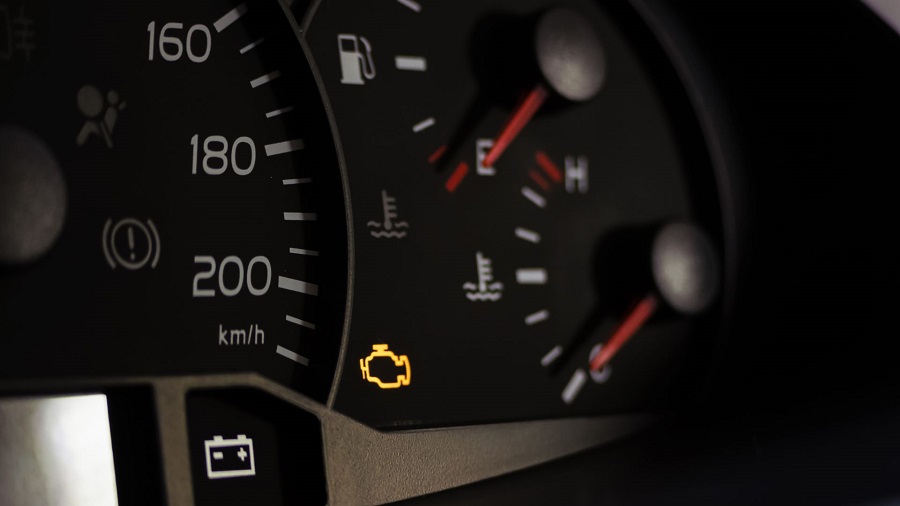
Few automotive quirks cause as much quiet anxiety as an intermittent check engine light. It glows bright amber on your morning commute, stays stubbornly lit while you run errands, and then mysteriously disappears two days later. Because the car seems to run fine and the dashboard went dark, the natural temptation is to write it off as an electrical ghost or a temporary glitch.
Modern engine computers do not trigger warning lights by accident. When a check engine light appears and disappears without an obvious pattern, your vehicle is signaling that an operating parameter slipped out of its acceptable range, but only under specific circumstances. Understanding how your car decides to turn that light on and off is the fastest way to resolve the problem before it leaves you stranded or damages costly components.
How Your Engine Computer Decides to Turn the Light Off
To make sense of an intermittent light, you need to understand how onboard diagnostic systems (OBD-II) evaluate problems. Your vehicle’s engine control unit (ECU) monitors hundreds of sensor inputs every second. Automotive engineers recognize that real-world driving conditions create momentary fluctuations, so the system is designed not to panic over a single abnormal reading.
When a sensor registers a reading outside factory specifications—such as a brief spike in tailpipe emissions or a momentary hesitation in fuel delivery—the computer logs a pending code. At this stage, the light stays off. If that same irregularity occurs again across two consecutive driving trips under similar operating conditions, the computer promotes the fault to an active code and turns on the check engine light.
The clearing process works on the same logic in reverse. If you complete a specific number of consecutive trips (usually three or four complete drive cycles) without the computer detecting the fault, the system turns the light off automatically. The underlying issue has not necessarily resolved itself; rather, your recent driving conditions simply did not trigger the specific test threshold that caused the initial failure. The computer moves the fault into a stored code archive in its memory, where it stays until manually cleared or overwritten after dozens of clean warm-up cycles.
Frequent Causes of an Intermittent Warning Light
Because the light only illuminates when specific environmental and mechanical variables align, certain components are far more likely to cause random appearances than others.
Evaporative Emission System (EVAP) Leaks
The EVAP system captures fuel vapors from your gas tank and feeds them into the engine to be burned rather than vented into the atmosphere. A loose, worn, or improperly seated gas cap is the most famous cause of an intermittent light, but there is a reason it seems random: the ECU does not test the EVAP system constantly.
Most vehicles only execute an EVAP vacuum test when the fuel tank is between roughly 15% and 85% full, the engine is warm, and the vehicle has been parked or cruising at a steady speed. If your gas cap seal is drying out, it may hold pressure on a cool morning but leak during hot afternoon driving, causing the light to cycle on and off depending on weather and fuel levels.
Failing Oxygen Sensors
Oxygen sensors live in the blistering heat of the exhaust system, measuring unburned oxygen in your exhaust gases so the ECU can balance the air-fuel mixture. As these sensors age, their response time slows down. A deteriorating sensor might deliver acceptable readings during stop-and-go city driving, but lag behind when you cruise at sustained highway speeds. Once the sensor response time exceeds the ECU’s programmed threshold, the light triggers. When you return to lower-speed driving, the sensor may operate just well enough to pass several consecutive cycles, turning the light off again.
Borderline Catalytic Converter Efficiency
A catalytic converter that is just starting to degrade often triggers the infamous P0420 diagnostic trouble code intermittently. The computer monitors converter efficiency by comparing readings from the upstream oxygen sensor to the downstream sensor. This calculation requires precise conditions: a fully warmed engine, steady throttle, and highway cruising speeds. You might see the light turn on during a weekend road trip, only for it to vanish after several days of short neighborhood trips where the computer never ran that specific diagnostic test.
Light-Load Engine Misfires
Severe misfires cause the check engine light to flash rapidly, which demands immediate attention. However, minor or borderline misfires often produce an intermittent solid light. An ignition coil with deteriorating internal insulation or a spark plug with an excessive gap might fire reliably at idle and under moderate acceleration, but break down under high cylinder pressure—such as climbing a long grade in top gear. If the misfire count stays below the threshold that damages the catalytic converter, the light illuminates as an active fault and then turns off after a few days of gentle driving.
Thermostat and Engine Warm-Up Issues
Modern emissions standards require your engine to reach its closed-loop operating temperature within a strictly calculated timeframe. If your engine thermostat is beginning to stick partially open, the coolant may warm up slowly. On mild days, the engine might reach operating temperature fast enough to satisfy the computer. On a freezing morning, the warm-up cycle takes longer, causing the computer to flag a coolant temperature rationality code. Once warmer weather returns or you make several short trips in quick succession, the light turns itself back off.
Why You Should Never Ignore a Disappearing Light
A warning light that turns off on its own can easily create a false sense of security. Ignoring an intermittent problem carries genuine risks that can compound over time.
First, an engine operating with an active or pending fault code often runs in an open-loop or default baseline fuel mapping. This default setting protects the engine from catastrophic failure by running intentionally rich (adding extra fuel). Over weeks and months, that unburned fuel washes through the exhaust system, superheating the delicate internal honeycomb of your catalytic converter and eventually destroying it. Replacing an oxygen sensor or spark plug costs a fraction of the price of a new catalytic converter.
Second, your vehicle will fail an emissions or state inspection even if the light happens to be dark when you pull into the testing bay. When an inspection station connects to your vehicle’s OBD-II port, the testing equipment reads the system’s readiness monitors. An intermittent issue prevents those monitors from completing their diagnostic tests, resulting in an automatic failure for incomplete readiness.
How to Track Down the Source
You do not have to wait for the light to return to diagnose the underlying cause. Even when the dashboard indicator is dark, your vehicle’s computer usually retains the evidence.
Plug a basic OBD-II scanner into the diagnostic port under your dashboard. Instead of only checking for active codes, look for pending codes and historical codes. Most modern scanners, including budget-friendly handheld units, can read these stored entries.
When you retrieve a code, pay close attention to the freeze frame data. Freeze frame data is a digital snapshot of your engine’s operating parameters at the exact second the fault was recorded. It reveals vehicle speed, engine RPM, coolant temperature, fuel trim numbers, and throttle position. If the snapshot shows the fault occurred at 68 mph with the engine at 1,900 RPM on a fully warmed engine, you immediately know the issue is related to highway cruising rather than cold starts or idling.
Keep a brief mental log of when the light tends to appear. Note whether it coincides with a fresh tank of gas, rainy weather, heavy acceleration, or your first start of the day. Combining these observations with stored diagnostic trouble codes takes the guesswork out of troubleshooting and gives your mechanic—or your own weekend repair plan—a direct path forward.